

JS Mediation Services is the proud provider of Restorative Justice Services for both Papakura and Pukekohe District Courts in Auckland.
We work within the criminal justice system to facilitate restorative justice processes for cases that are referred by the Court. Our role is to provide a safe, structured, and respectful process that places the needs of victims at the centre, while holding offenders accountable for the harm caused.
What is Restorative Justice?
Restorative Justice (RJ) is a community-based response to crime. It is an approach to justice that focuses on repairing harm rather than simply punishing wrongdoing. The process recognises that crime affects not only the victim, but also families, whānau, and the wider community.
Restorative Justice provides an opportunity for those affected by an offence to come together in a carefully facilitated dialogue. This includes:
The victim
The offender
Family members or support people
Community representatives where appropriate
Participation is voluntary. The process is guided by accredited restorative justice facilitators who ensure that everyone is heard respectfully and safely.

The Restorative Justice Conference
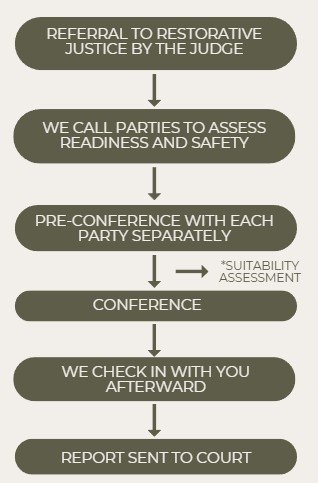
During the conference:
Victims are given the opportunity to speak about how the offence has affected them such as emotionally, financially, and practically and what they need in order to heal and move forward.
Victims may also speak about how others, such as children, whānau, or family members, have been impacted.
Offenders are given the opportunity to explain what led to the offence.
Offenders can share the steps they have already taken to address their behaviour, such as attending relevant programmes or seeking support.
Offenders hear directly about the impact of their actions.
Offenders are encouraged to take responsibility and acknowledge the harm caused.
All participants discuss meaningful and practical steps that can be taken to repair the harm.
The conference focuses on offender accountability, understanding of the impacts on the victims, ways the offender can repair the harm, and restoration and healing.
Following the conference, a Restorative Justice Report is prepared. This report records each participant’s understanding of the events leading up to the offence.
It outlines:
The offender’s understanding of how the offence has harmed the victim(s), their whānau, and the wider community
The steps the offender has taken, or is willing to take, to reduce reoffending
The actions proposed to repair the harm caused
The victim’s account of the impact of the offence
What the victim has identified as necessary or helpful to support healing and moving forward
The report also documents any agreements reached during the conference, such as apologies offered, reparation, participation in programmes, or other restorative actions.
The completed report is then provided to the Court, Police Prosecution, and the offender’s counsel. Copies are also made available to both the victim and the offender.
How the process works
When a case is referred by the Judge, our facilitators begin by meeting separately with the victim and their support people, and with the offender and their support people. These preparation meetings (restorative justice pre-conferences) are a vital part of the restorative justice process.
Restorative Justice Pre-Conference (preparation meetings)
For Participants, these meetings provide an opportunity to:
Meet with the facilitators and build understanding of the process
Ask questions and raise any concerns
Share their understanding of the events that led to the offense
Discuss how they have been affected
Identify what would help bring closure, healing, and a way forward
For Facilitators, these meetings allow us to:
Hear each participant’s account
Assess safety and readiness to proceed with a restorative justice conference
Ensure participation is informed and voluntary
Identify what each person hopes to achieve through the process
If all parties agree to proceed, and the facilitators assess the matter as appropriate and safe to continue, a restorative justice conference is scheduled. The conference involves the victim, the offender, and their respective support people.
Restorative Justice Report
Have questions about Restorative Justice?
-
For people who have experienced the crime, RJ gives you an opportunity to share how the crime has impacted you and what would help you and your whanau heal and move forward.
For people who have committed the crime, it is your opportunity to own up and take responsibility for your actions. It is a chance to show genuine remorse, to hear how your actions have impacted others, and to hear what you can do to support the healing process.
It is a powerful process of forgiveness, healing and restoration. Most importantly, it recognises that justice is not only about punishment. it is about repairing harm and restoring balance where possible. We at JSMS are committed to supporting you along this journey.
-
Restorative Justice practitioners are neutral, trained professionals who ensure that:
The process remains safe and respectful
Participation is informed and voluntary
Offenders understand the impact of their behaviour
Agreements are realistic and meaningful
It is not the role of the facilitator to take sides, or to reconcile relationships.
-
Restorative Justice cases are referred to us by the Judge presiding over the Court. Once cases come to us, we carefully assess each case to ensure it is suitable for restorative justice.
Not all cases are appropriate for a conference, and the wellbeing of participants is always the priority.
-
At JSMS we welcome questions, as we recognise that this may be a daunting process for you. Please feel free to email us at referrals@jsms.co.nz. Please also feel free to approach our Court Coordinators who are available on some days at Pukekohe and Papakura District Courts. They will be more than happy to answer any questions.